Bacterial Reproduction and Growth Are the Most Rapid Between
Bacteria reproduce very fast that a colony of bacteria will double in just half an hour. It is suggested that the replication of the bacterial genome during the division cycle of Escherichia coli growing with doubling times between approximately 20 and 60 minutes can be described by.

Binary Fission And Other Forms Of Reproduction In Bacteria Department Of Microbiology
Of cells as one cell gives rise to two progeny cells.

. Log Phase Exponential Phase. Nutrients enter the bacterium through pores in its membrane and undergo a series of chemical transformations converting them into new cellular components. The mol G C of the DNA is.
Bacteria are prokaryotic organisms that most commonly replicate by the asexual process of binary fissionThese microbes reproduce rapidly at an exponential rate under favorable conditions. Conditions that are optimal for the cells will result in very rapid growth and a steeper slope on the growth curve while less than ideal conditions will result in slower growth. Generation time until nutrients depletedwaste products reach toxic levels.
It is a rapid process and takes minutes to complete. Enters the lytic pathway to produce active phages and lyse the host cell usually under stress conditions like UV light antibiotic exposure etc eg. Traits linked with plantmicrobe interactions.
The most important vitamin for the growth of bacteria is A. When bacteria are added to a medium they require time to adept to the new environment before they begin dividing. Shiga toxins Stx1 and Stx2 of EHEC.
Show full abstract between 50 and 82C. Cell walls contain peptidoglycan. - Start immediately after inoculation of the cells into fresh medium.
When grown in culture a predictable pattern of growth in a. Protegens CHA0 harbours several traits that are linked to plant growth including production of antibiotics and plant hormones. Between each of these phases there is a transitional period curved portion.
- Although there is no apparent cell division occurring the cells may be growing in volume or mass synthesizing enzymes proteins RNA etc and increasing. Drug resistance in bacteria is mainly determined by factor. The bacteria will grow and divide at a doubling time characteristic of the strains and determined by the conditions during the exponencial phase.
Next the genetic material inside the bacterium uncoils. - Bacteria begin growing at a rapid rate and the population doubles at regular interevals. The most common means of bacterial reproduction is by binary fission.
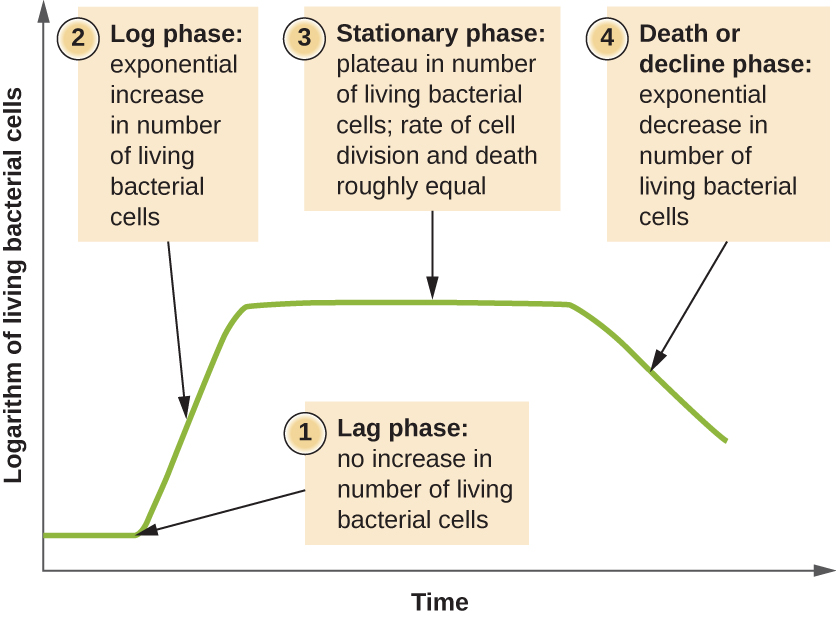
Therefore the Bacterial growth curve consists of 4 different phases such as the lag phase the exponential or logarithmic phase stationary phase and death or decline phase. This hiatus is known as lag phase of growth. These chemical transformations are collectively known as metabolism 26 27.
In fermenting the molasses and rapid yield in biotechnology etc. The single DNA molecule duplicates in this sort of asexual reproduction and both copies bind to the cell membrane at distinct places. Reproduction Growth Bacteria.
Bacteria grow to a fixed size then divide into two identical daughter cells in a single round of binary fission. Lag phase A log phase or exponential phase B stationary phase C and death phase D. - The population remains temporarily unchanged.
The increase in biomass is accompanied by an increase in cell. It is the period where the individual bacteria. Best growth occurs between 74 and 76C at pH 6070.
At the level of the individual bacteria the process of growth and replication is known as binary division. To assess these traits we grew each bacterial colony in 96-well plates containing. Since binary fission produces identical cells bacteria can become more genetically varied through recombination which involves the transfer of genes between cells.
Cells in the exponential phase of growth are the. Bacteria are the most metabolically active. Binary fission is used by most bacteria including Salmonella and Ecoli.
The distance between the two DNA molecules grows as the cell grows and elongates. First the parent bacterium grows and becomes larger. Unlike most multicellular organisms like you and I who undergo sexual reproduction bacteria multiply themselves through binary fission a type of asexual reproduction.
Most prophage genes are usually silent during bacterial growth and reproduction and are functional only when the prophage is activated induced ie. This represents the time required before all cells enter the new phase. Most rapid growth from end of lag to 18-24h maximum metabolism cell doubles with each.
Hence they can perform many duties on the earth like scavenging the dead and waste. The ion that is required in trace amounts for the growth of bacteria is A. Bacterial growth consists of the conversion of chemical nutrients into biomass.
During lag phase bacteria adapt themselves to growth conditions. Phases of the Growth Cycle Four characteristic phases of the growth cycle are recognized in vitro. In autecological studies the growth of bacteria or other microorganisms as protozoa microalgae or yeasts in batch culture can be modeled with four different phases.
They grow at an exponential rate 2 n nno. Bacterial growth were determined after 3 days of growth at 20 C without shaking as optical density at 600 nm. Binary fission as a means of reproduction has a number of benefits chief among them is the ability to reproduce in high numbers at a very rapid rate.
Growth proceeds most rapidly at the optimum growth temperature for a particular bacteria and decreases as temperature is raised or lowered from this optimum For any bacteria there is a minimum and maximum temperature beyond which growth is not supported. They can reproduce in many ways yet maintain genetic diversity and robustness. A chemostat gives a constrict flow of new media inold out including waste products maintains culture in log phase.
B Sexual reproduction. The growth medium is exploited at the maximal rate the culture reaches the maximum growth rate and the number of bacteria increases logarithmically exponentially and finally the single cell divide into two which replicate into four eight sixteen thirty two and so on That is 2 0 2 1 2 2 2 32 n n is the number of generations This will result in a balanced. The exponential or log phase of growth is marked by predictable doublings of the population where 1 cell become 2 cells becomes 4 becomes 8 etc.
Binary division occurs in stages.

Prokaryote Growth And Reproduction Advanced Ck 12 Foundation
How Microbes Grow Microbiology
Binary Fission And Other Forms Of Reproduction In Bacteria Department Of Microbiology


Comments
Post a Comment